
Contents
- What this Page Covers
- What is a Gallows Bracket?
- What is a Gallows Bracket Used For?
- Do Gallows Brackets Require Planning Permission?
- Regulations When Installing a “Gallows Bracket”
- FAQs
What This Page Covers
This guide explains:
- What a gallows bracket is and when it’s used
- When you need one during chimney breast removal
- Key building regulations and permissions
What is a Gallows Bracket?
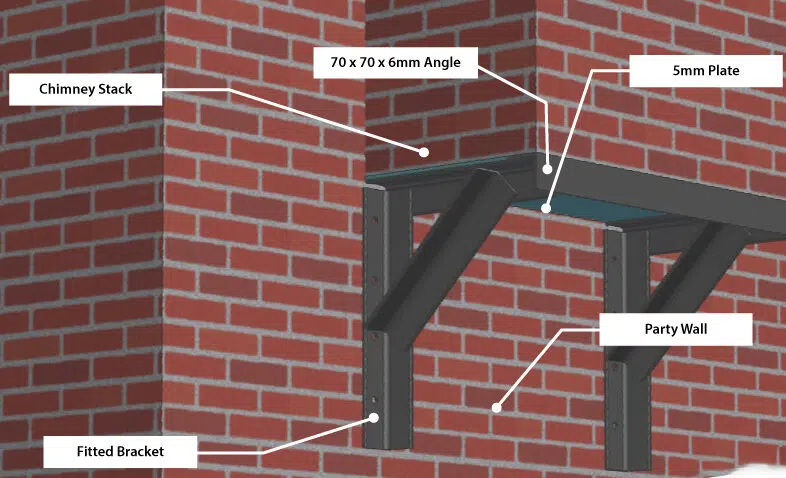
In the simplest of terms, a “Gallows Bracket” is steel support that is shaped at a right angle and used to support a chimney stack or breast when alterations to either are being carried out to prevent the chimney from collapsing.
They usually sit in the property owner’s loft and support the stack (the party of the chimney which extends out of the roof). They offer several benefits:
- They’re a cost-effective solution
- They’re strong and robust for reliable support
- They’re easy to install
What is a Gallows Bracket Used For?
As a chimney forms a part of the integral structure of a building, when a chimney is being repaired or removed, the remaining stack above and/or below it must remain steady. Support can be provided by a steel beam under the remaining chimney which spans the load bearing walls, but a Gallows Bracket installed at the Party Wall juncture is the most common suggestion from builders.
Do Gallows Brackets Require Planning Permission?
There are certain regulatory and statutory matters that must be adhered to when removing and/or altering a shared chimney stack on a party wall. These include, but are not limited to, planning permission under the Town and Country Planning Act 1990, certain building regulations and the Party Wall etc. Act 1996.
However, permission from the planning department of the local council is not required if the proposed works are to remove an internal chimney breast (i.e., removal of the chimney below the roof line) or a chimney that does not form a part of a party structure. (i.e. a bungalow or house).
With regard to building regulations, these only apply if the proposed works are of a structural nature. Thus, as a chimney forms a part of the structure of a building and a “Gallows Bracket” is considered to be a new structure that supports the remaining overhead load of a chimney breast and stack, building control approval is required from the local council.
If the chimney stack is situated on a shared wall, a Party Wall agreement is usually required before fitting the bracket.
Regulations Pertaining to the Installation of a “Gallows Bracket”
- The party wall to which the Gallows Bracket is to be affixed must be no less than 225mm thick.
- The wall must be made of solid brickwork and it must be in a satisfactory condition (i.e., no serious cracks or bulges).
- The width of the chimney breast can be no more than 1200mm. If wider, the appointment of a structural engineer is required.
- The projecting chimney breast must not be any more than 340mm into the room.
- The overhead chimney breast that is to be retained is not higher than two storeys (inclusive of roof space).
- The brickwork above the line of the chimney cannot be more than that beneath it, otherwise, the wind may cause the stack to collapse.
- The minimal height of a ‘Gallows Bracket’ must be 1.5 times the projection of the chimney breast.
If any of the above stated building regulations, or indeed others that have not been mentioned, cannot be complied with, then another type of support mechanism, such as a structural steel beam (RSJ) may need to be used.
Anyone proposing to carry out chimney removal or alteration works should take note that building permissions are granted by local councils who have discretionary power to refuse to allow the use of ‘Gallows Brackets’ as a supporting mechanism for the structures of local buildings.
Alternatives to Gallows Brackets
In some situations, other solutions are safer or required. For example, there are sometimes fire safety issues with Gallows Brackets if the chimney is part of a shared party wall. Your builder will need to ensure the alterations do not compromise the fire-tightness of the flue and that the steel brackets are boxed in using fire-rated plasterboard to provide protection in the event of a fire, so the building can be evacuated before any structural collapse occurs.
Some alternative options include:
- Steel beam (RSJ): This spreads the load across the walls
- Full chimney removal: Removing the chimney eliminates the weight load entirely
- Support from below, where the structure allows
A structural engineer will recommend the best option.
FAQs
Do I always need a gallows bracket when removing a chimney breast?
No. It depends on the structure. In some cases, a steel beam or full removal is required instead.
Can I install gallows brackets myself?
This is not recommended. Structural work should always be designed and approved by professionals.
How much weight can gallows brackets support?
This varies depending on design and installation. A structural engineer will calculate safe load limits.
What happens if I don’t use proper support?
The remaining chimney could become unstable, leading to cracking or collapse.
Are gallows brackets accepted by all councils?
Not always. Some councils prefer steel beams instead, so approval must be confirmed beforehand.
Do I need a structural engineer?
In most cases, yes—especially if the chimney is large or outside standard guidelines.
Icon Surveyors are happy to provide free party wall advice to any building or adjoining owners who may be affected by the subject matter raised in this blog.
Notice*: This blog is not an authoritative interpretation of the law; it is intended as a general guide.
Last Updated: March 2026
Reviewed by a Party Wall Surveyor.
